



Customers are increasingly cautious about answering calls and opening messages from unfamiliar numbers. Spam, spoofing, phishing, and inconsistent caller information have trained consumers to hesitate, even when the communication is legitimate and important.
Rich Communication Services, or RCS, and Branded Caller ID, or BCID, help businesses address this trust gap. Together, they create a more recognizable, secure, and interactive customer communication experience across both messaging and voice.
What Is Branded Caller ID?
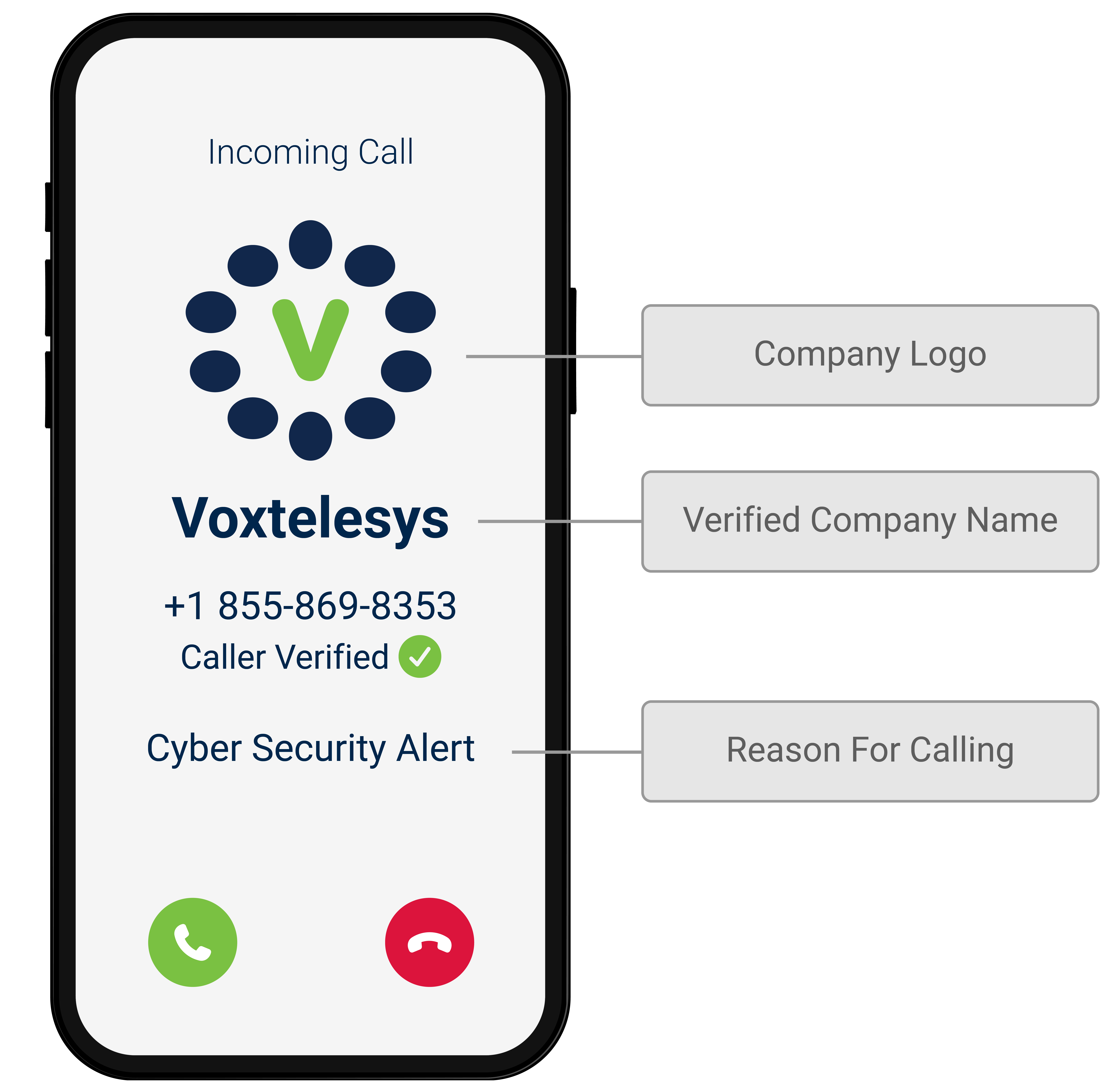
Branded Caller ID allows an organization to display verified information when calling a customer, including:
- Business name
- Company logo
- Call reason
- Verified calling status
Unlike traditional CNAM information, which may be outdated or controlled by third-party databases, BCID gives businesses greater control over the identity presented to the recipient. The goal is to ensure that customers see accurate, current, and recognizable information when the phone rings.
The Benefits of BCID
More Calls Get Answered
A recognizable business name, logo, and call reason help customers understand who is calling and why. This additional context can make customers more comfortable answering instead of allowing the call to go to voicemail.
This is especially valuable for organizations delivering urgent or time-sensitive information, such as:
- Outage notifications
- Appointment reminders
- Fraud alerts
- Payment assistance
- Service updates
- Customer-support callbacks
Greater Protection Against Spoofing
BCID works with authenticated calling technologies such as STIR/SHAKEN. Calls can be cryptographically signed so terminating carriers can verify the originating identity and confirm that the displayed brand information was properly vetted.
Because the brand identity is tied to authenticated calling information, a spoofed call cannot simply inherit the verified name and logo of a legitimate business.
More Consistent Brand Presentation
Traditional caller-name databases can contain outdated, abbreviated, or incorrect information. BCID allows businesses to maintain a more consistent identity across supported devices and networks. Instead of presenting only a telephone number, the call can communicate both the organization’s identity and the purpose of the interaction.
Improved Call Analytics Posture
BCID can support improved trust, but it does not replace responsible calling practices. Businesses must still maintain strong call analytics hygiene, including:
- Using valid and dialable numbers
- Assigning one number to a defined purpose
- Gradually warming up new numbers
- Avoiding sequential or random dialing
- Monitoring complaint and blocking rates
- Maintaining predictable calling patterns
- Preserving BCID and STIR/SHAKEN information throughout the call route
These practices help carriers and analytics providers distinguish legitimate business communications from suspicious traffic.
What Is RCS?
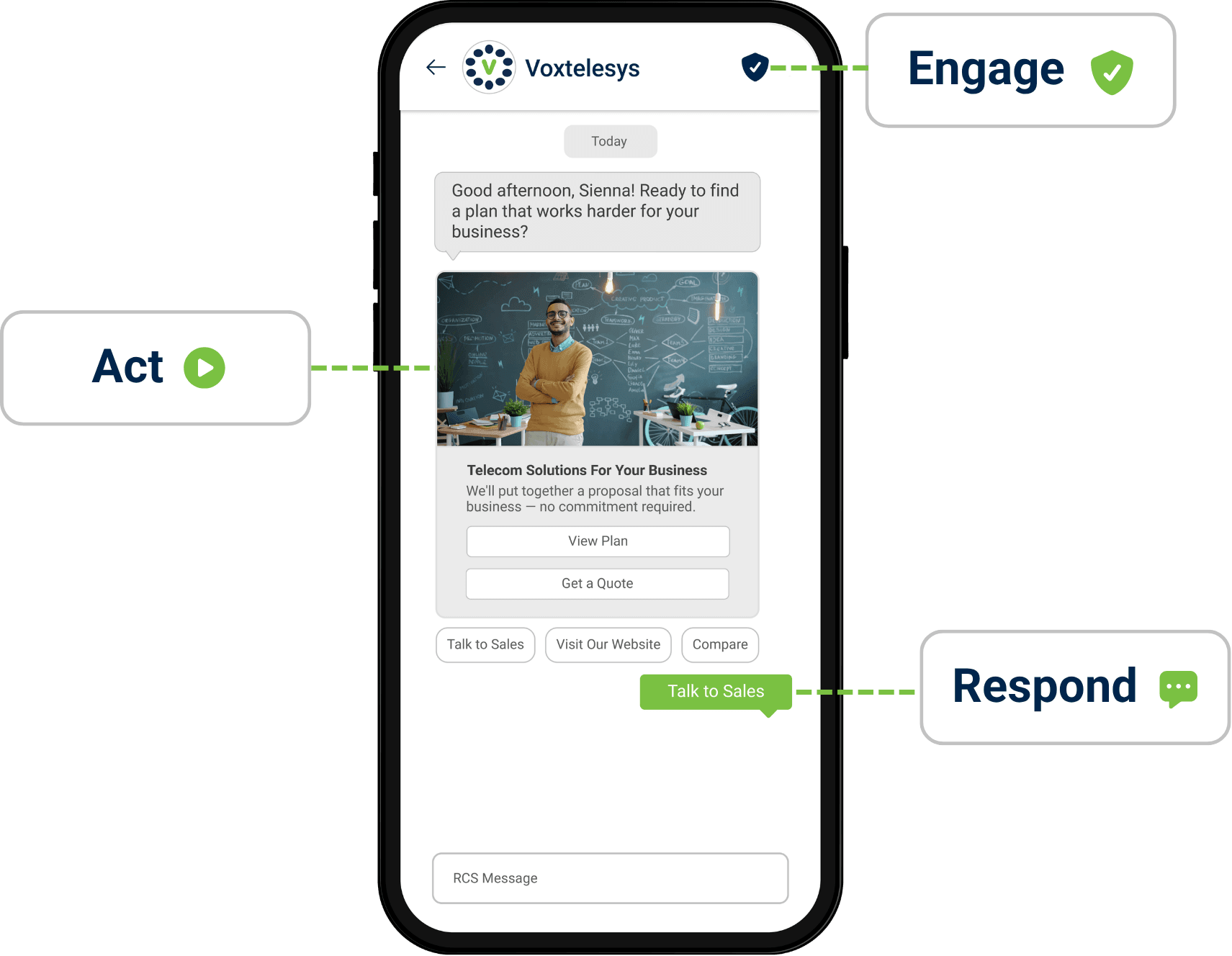
RCS is an advanced business messaging channel that expands the capabilities of traditional SMS. It allows organizations to deliver branded, interactive, and media-rich communications within the customer’s native messaging application.
An RCS conversation can include:
- Verified business identity
- Company logo and branding
- Images and video
- Documents and location information
- Suggested replies
- Action buttons
- Rich cards
- Scrollable carousels
- Two-way messaging
- Message-view status
The result is a more conversational interaction that allows customers to understand the message and take action without moving through multiple applications or websites.
The Benefits of RCS
Verified Business Messaging
RCS messages can appear under a registered business name with a company logo and verified indicator, replacing the unfamiliar numeric short codes commonly associated with legacy SMS.
This branded identity helps customers recognize the sender immediately and provides an additional defense against impersonation and messaging-based phishing.
More Interactive Customer Communications
Traditional SMS is primarily text-based. RCS allows businesses to add images, videos, maps, documents, structured responses, and action buttons directly within the conversation. For example, a customer receiving an appointment reminder could:
- Confirm the appointment
- Reschedule
- Add it to a calendar
- Call the office
- Open directions
Each action can be completed with a single tap.
Faster Customer Self-Service
Suggested replies and actions can help customers resolve routine requests without contacting a call center. A message can include buttons that allow the customer to:
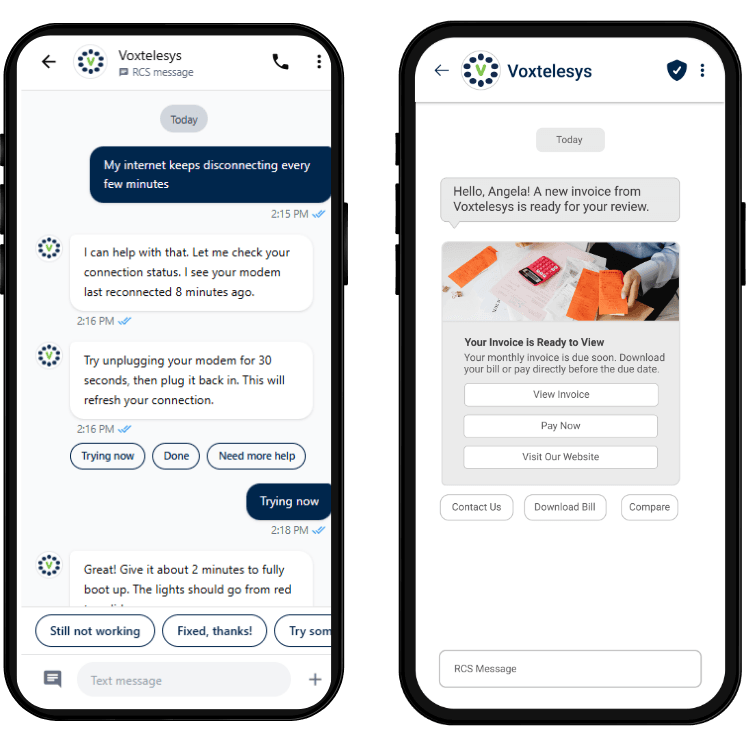
- Pay a bill
- View an invoice
- Report an outage
- Confirm their safety
- Request a representative
- Update contact information
- Open a support page
By making the next step clear and accessible, RCS can reduce unnecessary inbound call volume and simplify common customer-service interactions.
Stronger Calls to Action
Rich cards combine an image, headline, message, and action buttons into a single structured communication. Instead of sending a customer to a separate landing page, the offer and response options can be presented directly inside the message thread.
Scrollable carousels can also present multiple services, plans, products, restoration updates, appointment options, or assistance programs within one message.
Better Visibility Into Customer Engagement
RCS can provide message-view status, giving businesses greater insight into whether a communication has been seen. Combined with delivery reporting and customer responses, this information can help organizations determine when to:
- Send a follow-up
- Change communication channels
- Escalate to a voice call
- Stop unnecessary retries
- Route the customer into a different workflow
Why RCS and BCID Work Better Together
RCS and BCID solve different parts of the same challenge. BCID establishes trust when the customer receives a phone call. RCS establishes trust and creates an interactive experience when the customer receives a message.
Together, they support a coordinated communication strategy:
- A customer receives a verified RCS notification.
- The message explains the purpose of the communication and offers self-service options.
- The customer can respond, select an action, or request assistance.
- When a voice call is required, the customer receives a branded call showing the business name, logo, and call reason.
- Reporting captures activity across both channels.
This approach creates continuity. The customer sees the same trusted brand whether the interaction occurs through messaging or voice.
Practical Use Cases
Utility Communications
Utilities can use RCS and BCID to support:
- Outage alerts
- Estimated restoration updates
- High-bill notifications
- Payment assistance
- Medical-priority outreach
- Energy-efficiency programs
- Service-restoration confirmations
For instance, an outage workflow could begin with an RCS alert containing a map or restoration link. Customers who need additional assistance could request a call and receive a branded callback.
Financial Services
Banks and financial institutions can use the technologies for:
- Fraud notifications
- Account verification
- Payment reminders
- Loan servicing
- Appointment scheduling
- Secure customer callbacks
A verified message followed by a branded call helps the customer distinguish legitimate account outreach from phishing or impersonation attempts.
Healthcare
With RCS and BCID healthcare providers can support:
- Appointment reminders
- Scheduling changes
- Prescription notifications
- Patient surveys
- Follow-up instructions
- Billing communications
Customers can confirm or reschedule through RCS and receive a recognizable branded call when direct assistance is needed.
Customer Service and Field Operations
Organizations can also use RCS and BCID for:
- Technician arrival notifications
- Delivery updates
- Service scheduling
- Customer satisfaction surveys
- Support case updates
- Emergency notifications
Building a Trusted Multichannel Strategy
The strongest communication programs do more than add a new channel. They coordinate identity, content, routing, compliance, customer preferences, and reporting across the entire interaction.
Voxtelesys combines carrier-grade voice, branded calling, RCS, SMS, and automation within a common communications platform. Voxtelesys is an active BCID partner and Signing Agent/OSP, supporting branded calls with a verified name, logo, and call reason. Its messaging capabilities include branded RCS, SMS and short-code delivery, automated failover, direct carrier relationships, and high-throughput delivery.
Through missio™ Canvas, organizations can design automated workflows that move between RCS, SMS, voice, email, and customer-response tools based on customer data and real-time behavior.
The Future of Business Communication Is Recognizable and Conversational
Customers should not have to guess whether an important call or message is legitimate.
BCID makes business calls more recognizable and resistant to impersonation. RCS turns messaging into a verified, visual, and conversational channel. Used together, they help organizations improve trust, increase engagement, simplify customer actions, and create a more consistent experience across voice and messaging.
For businesses that depend on reaching customers quickly and reliably, RCS and BCID are not simply branding features. They are foundational components of a modern customer communication strategy. Contact us Today!